Tag: communities for good

  • The Emblem of Good

    The Emblem of Good

    Context

    Have you ever wondered why nowadays there is so many protests happening around the world but nothing is happening… no traction. But then if we look at all the movements, we can see the most successful one have 2 things:

    • An easy to understand common goal
    • A symbol or physical distinction allowing members of the group to recognize themselves easily from day to day.

    Think about it this way, the most successful groups are religion. And they often wear their religious icons on them throughout the day.

    As for examples of great protests, we can remember Gandhi’s salt march and the American civil right’s act, Each examples showed groups joining based on race, which made it very easy to see who the members of the movement were.

    When I came to this realization, I had to take a moment to reflect. This meant if I wanted a successful movement encouraging the 6 virtues of good, I would need to find a symbol to use. This would allow people involved to recognize each other easily AND work as advertisement for the ideology.

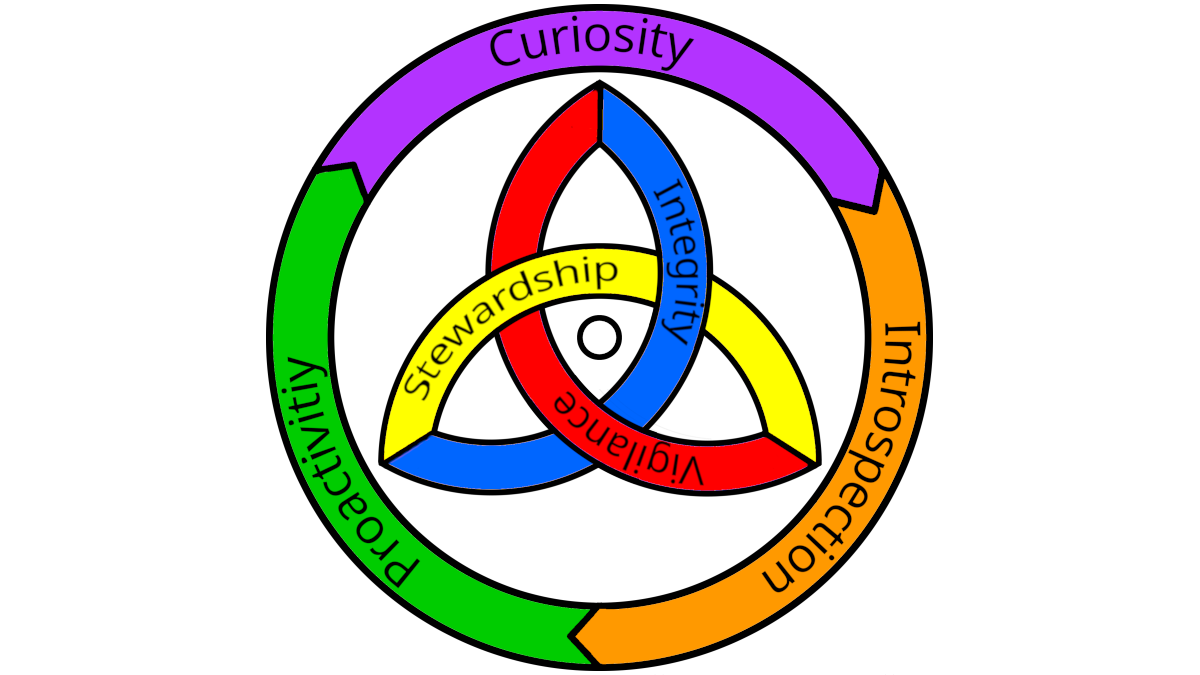
    After multiple iterations, I settled on this version and I wanted to explain what it represents.

    • Each virtues of good are spelled out to avoid ambiguity
    • The white circle in the middle is the self
    • The Trinity knot represents the virtues of stability tied together to keep society stable.
    • The outer ring represents the virtues of exploration and the potential it represents.
    Virtues Of Good

    Going down a rabbit hole

    I was happy with this symbol, but the iteration I settled on didn’t have the arrows at first. But after looking at it for a while, I noticed curiosity, introspection and proactivity has a flow to them. Curiosity allows you to learn new information, then introspection allows you to understand how this new information can impact you and finally proaction brings it all together to improve things. I saw these virtues as creating a virtuous cycle, thus I added the arrows.

    As for the colors, I picked the ones that seemed fitting looking at the colors through history and their meaning while using the 6 most used colors of the color wheel. And hey, look at that, the outer ring segment colors are a mix of the 2 primary colors of each virtues forming the closest tip. Wait …

    • Curiosity (a mix of the colors of integrity and vigilance) need these 2 virtues
      • Integrity helps spread the new information correctly
      • Vigilance helps us make sure the information is correct and not harmful.
    • Introspection (a mix of the colors of vigilance and stewardship) need these 2 virtues
      • Vigilance protects us from harm
      • Stewardship makes us appreciate our role in the greater system to avoid becoming selfish.
    • Proaction(a mix of the colors of integrity and stewardship) need these 2 virtues.
      • Integrity allows us to share the actions we want to take truthfully to make sure society is not hurt by the change
      • Stewardship helps leaders make decision beneficiary for everyone, not only themselves.

    Related Video(s)?

  • The 6 Virtues Of Good

    The 6 Virtues Of Good

    Context

    As I was enjoying a beer with my brother, I couldn’t help myself and discuss about what the definition of “objective good” would be. As a man in my 40s, this might sound like a childish question with no real answers. However, I needed guidance for what I should do next with my life because I am done with what I was “supposed” to do. Wife? Check House? Check. Successful career? Check Children? Check and check.

    I was entering a new frontier and if I was going to go outside the beaten path; I’d make sure it would be seen as “good”. Over the years, I learned the definition of good constantly shift depending on who is talking to me and what they needed at the moment. Did it mean good was doomed to be subjective?

    Before giving to despair, I decided to look at religion (Buddhism and Christianity) and philosophy / psychology (6 core virtues and Stoicism). The 6 core virtues were close: wisdom, courage, humanity, justice, temperance, and transcendence. But they lacked … precision. Let’s go over the list and explain why each words fall short.

    • Wisdom means the love of learning. However, most people will see it as being older and having a longer life… or worse seeing it as respecting rituals and dogma
    • Courage means braving your fear to do the right thing. However, most people will see it as blindly and recklessly acting without thinking.
    • Humanity means being kind and socially aware. This word is problematic because humanity through the ages has been used as a way to place humans as superiors while focusing on humanity as a race.
    • Justice means leadership and teamwork. I think this word is off because justice instantly recalls laws and following dogma.
    • Temperance means self-regulation and avoiding giving in to our impulses. This has a similar problem to Buddhism in my eyes; it encourages inaction and can let bad actors take over fairly easily.
    • Transcendence is there to remind us to appreciate the greater system we are a part of and through spirituality find meaning in our lives. I appreciate encouraging people to reflect and appreciate what they have. However,

    To be clear, I don’t think these 6 virtues are bad; they are a good starting point. I think we need to give it a bit of an upgrade. Let’s see what we can do.

    • First, the virtues needs to work together somehow to avoid contradicting each other or stepping on each-others toes.
    • Second, let’s make sure to split the 6 virtues into 2 groups to make it simpler to understand. Usually in society there are 2 forces constantly fighting against each other.
      • The pull toward stability because change can be risky and a stable foundation can allow us to build great things.
      • The pull toward exploration to learn new things, grow and adapt to an ever changing world.
    • Third, let’s make sure these virtues don’t make their followers inactive and easy to manipulate.
    • Fourth, let’s add some art to anthropomorphize these virtues and make this already verbose blob post more fun.

    With this in mind, let’s see what 6 virtues we can come up with.

    The Virtues Of Stability

    Image of a book

    Integrity

    Definition

    The nervous system of society. We need to share information with no bias nor agenda. It involves:

    • Telling the truth even if it’s inconvenient
    • Being consistent
    • Living by the values your preach

    Details

    The most difficult virtue to enforce. Because the world is a constant prisoner’s dilemma, if you follow integrity and others don’t, you are screwing yourself up. However, a society where integrity is low can’t function for long. As deceit becomes more and more accepted, eventually the objective truth is lost and our grip on reality is loosens.

    It needs to be actively enforced, there is no such thing as a “noble lie”. Deceit and a lack of integrity needs to be called out, discouraged and even punished.

    Image of a book

    Vigilance

    Definition

    The immune system of society, it protects against harmful forces. If the immune system is over-sensitive, it starts to attack the body and destroy it; however, if the immune system is weak, the body can get sick and eventually die. It involves:

    • Searching for harmful problems and resolving them
    • Analyze new information and assess it’s usefulness

    Details

    The easiest virtue to misuse. We often hear about people attempting to share truthful information and being silenced. Because we are creature of habits, we need to actively fight our urge to refuse to learn new information.

    On the flip side, we can’t have bad actors able to harm others with impunity. Finding the perfect balance is a constant struggle.

    Image of a book

    Stewardship

    Definition

    The brain of society. It has a massive amount of power over the body and is able to distribute resources at its whim. However, it never takes more than it needs and it takes care of all parts of the body. It involves:

    • Respecting all things you have power over.
    • Appreciating all parts of the system we exist in
    • Improving the life of all things you have power over.

    Details

    Throughout humanity, we saw powerful figures as brilliant heroes able to change the tides of history on their own. Obviously, this is not true and is a result of our inability to keep track of thousands of humans working together.

    Leaders need to be seen as navigator guiding the efforts of countless humans to achieve incredible things. If a navigator becomes corrupted or guides us in a bad path, we need to be able to replace them.

    The Virtues Of Exploration

    Image of a book

    Curiosity

    Definition

    The senses of society. Interacting with the outside world and learning is what allowed humans to pull themselves out of surviving and into thriving. (even if recent times sometimes makes us doubt this xD ). It involves:

    • Internalize new information even if it’s disruptive and difficult.
    • Work hard to understand everything you interact with. You should take the time to learn more if you do not understand the information at first glance.
    • Seek the unknown and share the information you gain with others.

    Details

    This virtue has been villainized throughout the ages. We often hear thought terminating cliches such as “curiosity killed the cat” and “god works in mysterious ways”. Often, curiosity is punished because learning new things is painful and disruptive.

    We need to celebrate the people who are pushing our boundaries and making us uncomfortable. They are helping us learn and grow. Similar to personal trainers for our brains.

    Image of a book

    Introspection

    Definition

    The conscience of society. It forces everyone to understand their roles in the society AND in the world. It allows us to have a full picture of what we need as a human. We need to understand ourselves if we want to hope to find the best solution for the world. It involves:

    • Reflect on ourselves and understand what we need and what we want.
    • Understand our role in the greater world and see what our impact is.
    • Take time to do things for us and focus on our happiness.

    Details

    This virtue can be applied in multiple ways. The goal of this virtue is similar to how during an airplane crash we are asked to put our mask first before helping someone else put theirs.

    If very important needs goes unfulfilled for a long time, your body is forced to cope with this daily and eventually 1 of 2 things will happen. You will either become depressed and unable to do anything useful OR you will snap and do something you will regret later.

    Before going all in for a good cause, make sure you are in a good point in your life and can handle the extra stress.

    Image of a book

    Proactivity

    Definition

    The reward system of society. It takes the input of curiosity and introspection to understand what actions we need to take to improve things. Introspection is giving us the starting point and curiosity is giving us new information. Now it’s up to us to use these 2 points of data and find what is the right action to change things for the best. It includes:

    • Focusing efforts on researching solutions to future problems.
    • Seek to constantly improve things.
    • Take the time needed to understand what is the natural conclusion of an action taken for years.

    Details

    Proactivity and responding to adversity is how humans discovered most of their inventions. The cold brought us fire; infections brought us anti-biotics; food scarcity made us go around the world and invent agriculture.

    Problems are not a bad thing, they are a chance for us to discover how to do things better. The problem is when we take the easiest solution without thinking of the consequences in the long term.

    There are plenty of examples in history where short-sighted actions of leaders caused the death of countless people.

    Related video(s)?