
Tag: philosophy

  • The 6 Sins of Anomie

    The 6 Sins of Anomie

    Requirements

    • Each virtue must be paired with its corresponding sin, establishing the two points required to create vectors for ethical directionality.
    • The seven deadly sins provide a robust foundation; having endured for centuries, they have firmly stood the test of time. However, a few structural corrections are necessary.
      • Because gluttony and lust overlap significantly, they should be merged.
      • Conversely, envy is an innate, uncontrollable drive rather than a true vice.
      • Finally, because there is currently no sin anchored to the virtue of integrity, a new one must be defined to complete the vector.
    • The sins will be divided into two distinct groups to perfectly mirror the structure of the virtue categories.
      • Progress => Self-Destruction
      • Stability => Social Decay

    The Sins of Social Decay

    Greed

    Earth provides enough to satisfy every man’s needs, but not every man’s greed.

    Often regarded as the most destructive vice, greed turns natural collaborators into adversaries. Instead of seeing our fellow citizens as partners, we begin to view them as obstacles or problems to be managed.

    This mindset shifts our collective focus from maximizing societal gains to aggressively maximizing personal wealth. The primary danger is that self-interested individuals rarely see any fault in their behavior, falsely assuming that everyone operates under the same ruthless logic. However, if this hyper-individualism becomes universal, society gradually fractures until it collapses.

    While cooperative individuals actively sustain the health of the community, greed systematically drains its resources. Because this vice rewards the individual at the absolute expense of the collective, it carries no intrinsic drawback for the sinner, making it exceptionally dangerous. When an individual’s unchecked consumption causes widespread societal suffering, the community must intervene. We must either expel the problematic actor or, at the very least, strip them of any power or authority over others.

    It involves:

    • Viewing all human interactions as a battlefield where the victor is decided solely by who extracts the most value.
    • The value of an action is no longer measured by its objective, collective outcome, but solely by personal acquisition.
    • To erode the foundation of society by slowly draining its collective resources.
    Deceit

    It’s discouraging to think how many people are shocked by honesty and how few by deceit.

    Deceit has historically hidden behind the guise of the “noble lie,” making it society’s most elusive and destructive vice. We must treat fraud and deception with the same severity as physical violence.

    What begins as harmless “white lies” eventually distorts social reality, weaving truth and falsehood until they are indistinguishable. Because lying inherently benefits the liar, society must actively punish deceitful behavior before it collapses our collective foundations.

    It involves:

    • Lying for personal gain when it is not vital for our survival.
    • Omitting important information on purpose to coerce people while maintaining plausible deniability.
    • Deliberately using fallacies to manipulate public opinion.

    Image of a book

    Wrath

    Might makes right!

    This sin is often mistaken for a mindless, reckless force. In reality, its mission is far more devious: hatred. It convinces us to abandon compromise, debate, or understanding, demanding the destruction of the unknown.

    Violence should never stand in the way of innovation. Resentment has its place for communicating distaste, but it is never a solution. To defeat this vice, we must master our emotions and look inward. If we choose to reject something, we need a complete understanding of why.

    It involves:

    • Weaponizing anger to dominate arguments rather than engaging in rational thought.
    • Hating external factors simply because they cannot be forced to fit our norms.
    • Viewing new information as dangerous and responding with exaggerated force.

    The Sins of Self-Destruction

    Pride

    The more we have it in ourselves, the more we dislike it in others.

    Pride is a tool people use to protect their ego, but it ultimately limits them.

    This happens when we focus entirely on a specific personal strength, using it as the single metric to judge ourselves against everyone else. While this sin can be dangerous to society, it is usually most damaging to the individual. It stunts growth and kills happiness by blocking people out, leading to a lonely life, predictable behaviors and narrow interests.

    The ultimate danger of a prideful leader is power. It breeds deep resentment, allows the mistreatment of the defenseless, and ultimately kills a group’s innovation.

    The best antidote to pride is lifelong curiosity. We must constantly look outward and ask ourselves what others can teach us.

    It involves:

    • Ignoring others’ opinions because they are deemed inferior.
    • Judging the worth of one’s life by an narrow, limited set of parameters.
    • Minimizing the value of skills or areas where we lack proficiency.

    Excess

    The mother of excess is not joy but joylessness.

    This is probably the most entertaining sin and it feels relatively harmless at first. The real danger starts when it transforms into an all-consuming force, hijacking your thoughts and actions. Excess creeps up on us while we do things bringing us legitimate joy. It wears many masks: food, sex, gaming, alcohol, work, etc.

    Unlike other sins, it is healthy to give in a little, enjoy ourselves, and feel passionate. But like gravity, excess is a constant downward pull. If you aren’t careful, it sinks its hooks in until you can’t get out.

    The best defense is diversification. Build a life with many different sources of happiness to avoid over-relying on just one. Sampling all the healthy joys of life is the ultimate key to staying free.

    It involves:

    • Relying on only a few activities for happiness, leading to unhealthy obsessions.
    • Becoming defined by a highly limited number of traits and turning one-dimensional.
    • Anything outside our obsession becomes a meaningless annoyance.

    Sloth

    The point is there ain’t no point

    When life gets heavy, this sin is waiting to catch you. It offers comfort, telling you it’s okay to stop trying. It whispers that effort is pointless anyway.

    Sloth might be the least destructive sin to society, but it causes agonizing personal pain. It looks like salvation, but it only ensures the sinner suffers. In a way, sloth is the floor of life. Once everything is taken from you, it pins you down and slowly suffocates your spirit.

    Sadly, escapism and apathy fix nothing. They only cause life to worsen until a person gives up entirely. The ultimate weapon against sloth is connection. Just like quicksand, once it has its grip on you, you need help to get out.

    If life feels too difficult and you are thinking about ending it, please reach out. Call or text 988 to connect with the 988 Suicide & Crisis Lifeline. You do not have to go through this alone.

    It involves:

    • Seeing life as entirely meaningless and devoid of purpose.
    • Avoiding self-improvement because the effort feels too painful.
    • Becoming apathetic to the problems of the world.
    Music video before you go?

  • The Emblem of Good

    The Emblem of Good

    Have you ever wondered why there are so many protests happening around the world nowadays, yet nothing seems to change? They gain no real traction. This is because a successful movement requires two critical things:

    • An easy-to-understand common goal
    • A symbol or physical identifier allowing members to recognize one another quickly. This has the added benefit of making individuals feel they belong to something greater.

    The most successful movements are religions. We can see how members showcase their faith through imagery, necklaces, bumper stickers, and pieces of clothing. While most people think this is simply to show respect, we are smart enough to look closer and recognize the truth: it’s advertisement. This branding allows religions to grow organically, makes it easy for members to congregate, and helps them collectively reject outsiders.

    Historically, numerous successful movements have been catalyzed by deep-seated racial or colonial fractures. Examples include Gandhi’s Salt March, which mobilized Indians against British colonial rule, and the American Civil Rights Movement, which challenged the systemic oppression of African Americans by white Americans. Each example had an innate, built-in symbol based on the race of the movement’s members. This biological visibility bypassed the need to invent an artificial symbol, allowing the movement to scale and succeed quickly.

    When I came to this realization, I had to stop and think. If I wanted to build a successful movement around the six virtues of good, I couldn’t rely on ideas alone. I needed a symbol. A symbol would do two things at once: it would allow our community to instantly recognize each other, and it would serve as a powerful billboard for the ideology.

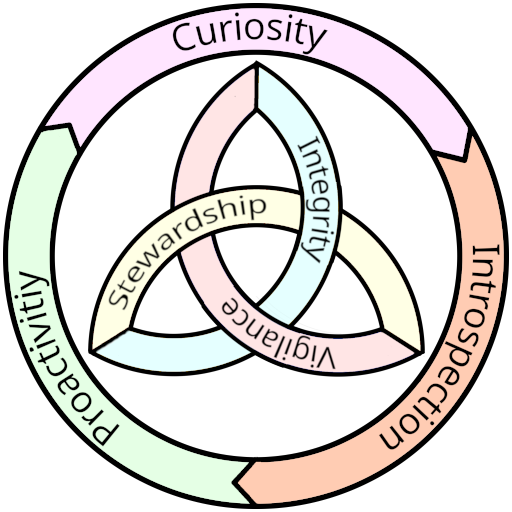
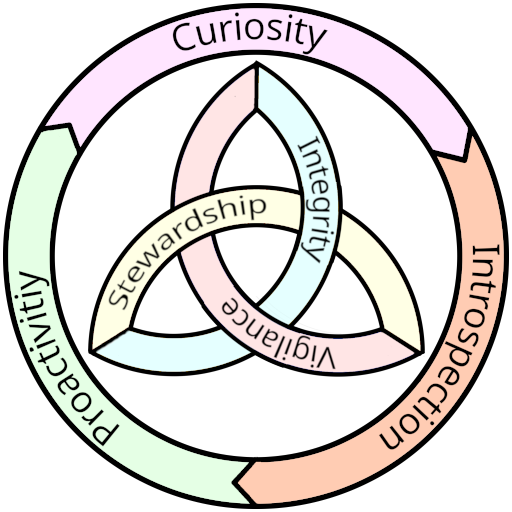
    After countless iterations, I finally settled on this version. Here is exactly what it represents:

    • Spelling out each virtue of good to avoid ambiguity.
    • The Trinity knot represents the virtues of stability working together to keep society secure.
    • The outer ring represents the virtues of change and their inherent potential. It symbolizes a virtuous cycle where curiosity gathers new information, introspection internalizes it, and proactivity applies the change. This cycle repeats ad nauseam, fueling continuous, lifelong improvement.

    Music video before you go?

  • The 6 Virtues Of Good

    The 6 Virtues Of Good

    Requirements

    • Humanity needs a clear path toward what is good. Otherwise, we will remain trapped in a continuous loop of growth followed by periods of decay.
    • The values of modern democracy (justice, freedom, equality, and liberty) will not do. They are too imprecise and lack real meaning. The six core values of positive psychology (wisdom, courage, humanity, justice, temperance, and transcendence) suffer from the same problem. Meanwhile, Buddhism encourages inaction and submission, a problematic stance allowing societal issues to worsen. Finally, the Christian Ten Commandments are a mixed bag and not particularly useful.
    • A better framework of virtues for humanity relies on balancing the two forces constantly at war in society: change and stability.
      • To prevent overcomplication, six virtues should be the absolute upper limit. Specifically, three dedicated to stability and three to change.
      • Finally, the virtues of stability must not compete with the virtues of change. Instead, they should work in tandem, ensuring that the traits meant to secure society never hinder the traits meant to improve it.

    The Virtues of Stability

    Stewardship

    The brain of society.

    The brain has a massive amount of power over the body, distributing resources at its whim. However, it never takes more than it needs and takes care of all body parts.

    Throughout history, we have viewed powerful figures as brilliant heroes capable of changing the tides of history on their own. Obviously, this is not true; it is merely a result of our inability to keep track of thousands of humans working together.

    Leaders should instead be seen as navigators, guiding the collective efforts of countless individuals to achieve incredible things. If a navigator becomes corrupted or guides us down a destructive path, we must be able to replace them quickly.

    It involves:

    • Improving the lives and conditions of everything within your sphere of power.
    • Respecting everything within your sphere of power.
    • Appreciating every component of the system in which we exist.

    Integrity

    The nervous system of society.

    We need to share information without bias or an agenda. This is the most difficult virtue to follow because the world operates as a constant prisoner’s dilemma; if you practice integrity while others do not, you end up hurting yourself.

    However, a society with low integrity cannot function properly. As deceit becomes more widely accepted, objective truth is eventually lost, loosening our grip on reality. Therefore, truth must be actively enforced because there is no such thing as a “noble lie.” Deceit and a lack of integrity must be called out, discouraged, and even punished.

    It involves:

    • Telling the truth, even if it is inconvenient.
    • Maintaining consistency in your actions, regardless of the situation.
    • Living according to the values you preach.

    Image of a book

    Vigilance

    The immune system of society,

    It acts much like an immune system, protecting against harmful forces. If the immune system is oversensitive, it starts to attack and destroy the body; however, if it is weak, the body gets sick and eventually dies.

    This is the easiest virtue to misuse. We often hear about people attempting to share truthful information only to be silenced. Because we are creatures of habit, we must actively fight our urge to reject new information while simultaneously preventing the spread of misinformation and corruption. This is a delicate balance we must always be mindful of.

    It involves:

    • Actively identifying and resolving harmful problems.
    • Analyzing new information and assessing its usefulness.
    • Safeguarding society while fostering room for personal experimentation.

    The Virtues of Progress

    Curiosity

    The senses of society.

    Interacting with the outside world and learning are what allowed humanity to stop merely surviving and start thriving. Yet, this virtue has been villainized throughout the ages. We often hear thought-terminating clichés such as “curiosity killed the cat” or “God works in mysterious ways.”

    Curiosity is punished because new information is disruptive and learning is painful. Instead, we need to celebrate the people who challenge us and push our boundaries further. They help us learn, grow, and become stronger; acting as personal trainers who make our collective brains fitter.

    It involves:

    • Internalizing new information, even when it is disruptive and difficult.
    • Working diligently to understand the world by taking the time to investigate and study unfamiliar problems.
    • Seeking out the unknown and sharing the knowledge gained with others.

    Introspection

    The conscience of society.

    It compels individuals to understand their roles within both society and the universe, providing a complete picture of human necessity. Ultimately, we must understand ourselves before we can hope to move forward.

    We are often told that during an inflight emergency, we must secure our own oxygen mask before helping others. This sound advice perfectly represents this virtue. We must understand ourselves and maintain a healthy state of mind before we can hope to make things better. Ignoring our own well-being for too long leads to depression or, worse, bitter resentment. Ultimately, neglecting our own needs harms both ourselves and everyone around us.

    It involves:

    • Reflecting on ourselves and understanding our core needs.
    • Understanding our social roles and assessing our impact on others.
    • Taking the necessary time to appreciate life and pursue personal goals.

    Proactivity

    The reward system of society.

    It takes the combined inputs of curiosity and introspection to understand the actions we must take to improve. Introspection provides our starting point, while curiosity delivers the new information we need.

    Proactivity in the face of adversity is how humanity discovered most of its greatest inventions: the cold brought us fire, infections brought us antibiotics, and food scarcity drove global exploration and the birth of agriculture. Adversity is not a problem; it is an opportunity for discovery.

    The real issue is that our laziness sometimes wins, tempting us to choose easy and short-sighted solutions to fix our problems. This flaw is at the root of why leaders so often pick options that cause unnecessary suffering.

    It includes:

    • Focusing efforts on researching solutions to future problems, rather than simply being reactionary.
    • Constantly seeking self-improvement.
    • Taking the necessary time to understand the future impact of an action, exercising true foresight.

    Music video before you go?